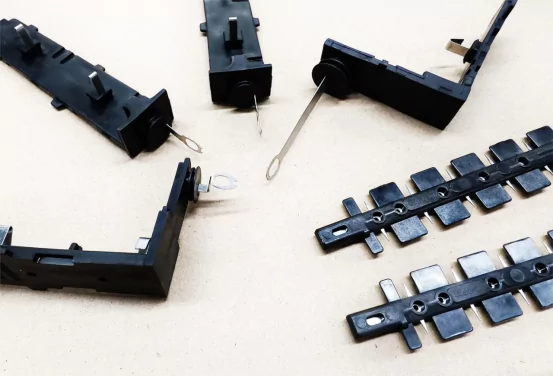
Transforming a digital concept into a physical polymer component requires a strategic evaluation of available industrial manufacturing methods. Product designers frequently weigh the benefits of rapid layer-by-layer deposition against traditional high-pressure molten resin replication. For companies seeking high-volume consistency, utilizing China custom plastic injection molding provides a reliable pathway to achieve tight tolerances and uniform material density.
Analyzing the Core Mechanics of Polymer Replication and Layer Deposition
High-pressure polymer molding operates by forcing completely molten thermoplastic material into a precision-machined metal cavity under immense clamping force. Once the cavity fills, the material cools uniformly, creating a homogenous solid component that mirrors the internal dimensions perfectly. This approach ensures that the physical properties remain isotropic, meaning the component exhibits identical strength in every direction.
Conversely, additive manufacturing builds parts sequentially by melting and depositing thin layers of filament or liquid resin on top of one another. This layer-by-layer adhesion introduces directional vulnerability, as the bonds between individual layers are inherently weaker than the base material itself. Consequently, additive parts are prone to delamination under severe shear or tensile stresses.
Material Diversity and the Integration of Advanced Engineering Polymers
The array of raw materials compatible with high-pressure cavity replication spans thousands of commercial-grade polymers, including highly specialized engineering blends. Materials can be reinforced with glass fibers, carbon fibers, or flame-retardant additives to achieve extreme stiffness and thermal stability. These complex composite blends flow smoothly under high pressure to fill complex geometries without losing their structural properties.
Additive equipment remains constrained by a much narrower selection of proprietary filaments, powders, or liquid photopolymers. Many common industrial materials, such as specific grades of polypropylene or automotive-grade polycarbonates, are difficult or impossible to print reliably. This limitation forces engineers to accept material compromises during functional testing phases.
Comparing Aesthetic Fidelity and Native Surface Finishing Diversity
Components emerging from a highly polished steel mold cavity possess exceptional native surface smoothness and crisp geometric definition right out of the machine. The process replicates micro-textures, matte grains, or high-gloss optical finishes directly from the tooling walls without requiring secondary labor. This clean exit saves considerable time during post-processing schedules.
Layered fabrication invariably leaves visible stair-stepping artifacts along the exterior curved profiles of the printed component. Achieving a commercial appearance requires extensive secondary operations such as manual sanding, chemical vapor smoothing, or bead blasting. These extra steps add labor costs and can inadvertently distort critical dimensional tolerances.
Evaluating Dimensional Stability and Batch Consistency Across Scale
Automated high-pressure replication provides unparalleled consistency, ensuring that the first molded piece is identical to the hundred-thousandth piece. The combination of automated material dosing, constant clamping pressures, and regulated cooling cycles eliminates structural and dimensional drift entirely. This predictability is vital for parts destined for complex automated assembly lines.
Additive systems can exhibit slight dimensional variations between different print jobs or different positions on the build platform. Factors like ambient chamber temperature fluctuations, cooling fan speeds, and nozzle wear introduce micro-variances that affect tight interlocking joints. For large batches, these slight variances create challenging quality control scenarios.
The Economic Threshold of Initial Tooling Expenses Versus Piece Price
The primary hurdle for high-pressure molding is the upfront capital expenditure required to design and machine the metal tooling inserts. This initial investment makes the methodology cost-prohibitive for low-quantity production runs or single-digit prototyping cycles. For low volumes, additive setups provide a highly economical solution since they require zero physical tooling.
However, as production volumes increase into the hundreds or thousands of units, the economic equation flips dramatically. The per-piece price of a molded part is incredibly low, often costing fractions of a cent due to ultra-fast cycle times. Additive manufacturing costs remain flat regardless of volume, making mass replication via printing highly inefficient.
Addressing Color Integrity and High–Volume Color Customization
Achieving specific corporate brand colors or structural color coding is easily managed within high-pressure polymer molding workflows. Raw polymer pellets are combined with highly accurate color masterbatches or liquid colorants directly inside the injection barrel before molding. This thorough mixing guarantees deep, uniform color penetration through the entire thickness of the component.
Adapting Production Frameworks to Diverse Industrial Applications
Automotive, medical device, and consumer electronics industries depend heavily on high-pressure molding to satisfy strict regulatory compliance frameworks. The ability to produce thousands of completely uniform, biocompatible, or flame-retardant parts continuously supports stable industrial supply chains. This process provides the structural reliability needed for critical enclosures and internal mechanical components.
Specialized High Pressure Replication Solutions for Global Brands
Taking a product from additive prototype to scalable commercial production is a critical milestone—and one best navigated with an experienced manufacturing partner. APT-Mold offers a full portfolio of custom manufacturing services purpose-built to support a smooth evolution into automated, high-efficiency production. The company’s specialized facility uses advanced automation to amplify consistency and drive high production rates for a diverse array of industries.
Conclusion
Choosing between injection molding and three-dimensional printing requires balancing production volumes against material requirements and budget limits. Additive manufacturing remains the ultimate choice for rapid design exploration and low-volume customization where tooling is impractical. However, for true material performance, surface perfection, and scalable consistency, high-pressure molding remains the indispensable standard for modern mass production.
