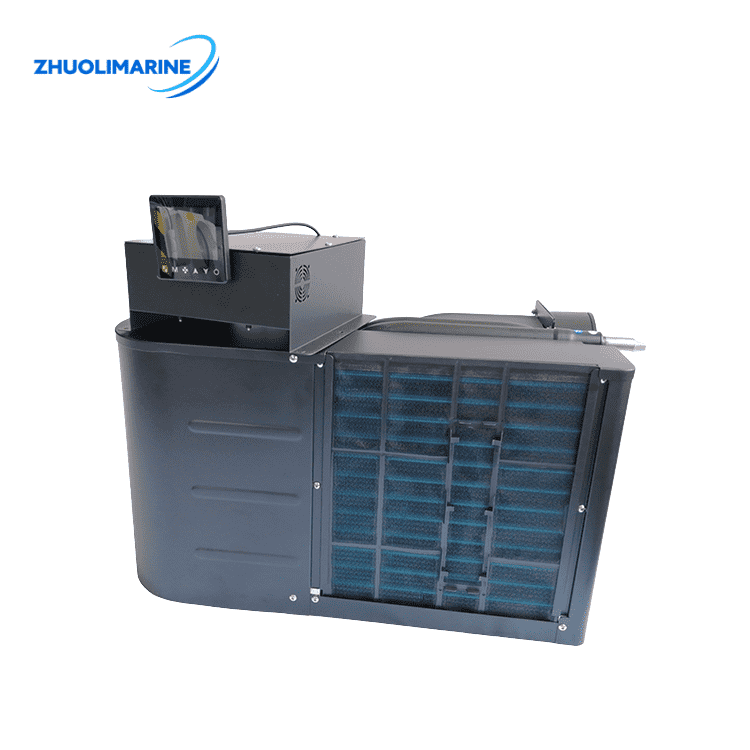
Matching cabinet dimensions do not mean that two air conditioners will behave the same once installed aboard a boat. One may require more current, another may move more air, and a higher-capacity version may call for greater seawater circulation without occupying a larger enclosure.
Comparing small air conditioning units for boats is consequently a three-part exercise: physical fit, electrical compatibility and the delivery of cooling through the actual cabin. None of these figures is meaningful in isolation.
Measure the Connection Envelope, Not Just the Box
A cabinet dimension describes the machine itself, not the usable compartment that will contain it. Hose connections extend beyond the casing; duct bends and service panels also need clearance. The available opening must allow installation and, eventually, removal. A model that enters a locker diagonally but leaves no access to its filter or wiring does not represent a successful space-saving choice.
The 9,000 BTU self-contained DC models offered by ZhuoliMarine share published dimensions of 480 × 330 × 335 mm. Their nominally compact form is useful for an initial drawing, but the vessel still needs an intake-water route, discharge arrangement and both supply and return airflow.
The supplied unit and thermostat are only part of the materials needed to complete an installation. Depending on the vessel, the pump, air ducts, grilles and filters may have to be sourced separately. Planning space around those components avoids treating a catalogue outline as the complete installation footprint.
Make Electrical Ratings Comparable
The currently listed models show how electrical demand varies with both cooling capacity and supply voltage. The MAR-12V/09BP delivers 9,000 BTU cooling with a rated input of 660 W and a current of 55 A. The MAR-24V/12BP provides 12,000 BTU cooling at 1,020 W and 42.5 A, while the MAR-48V/16BP delivers 16,000 BTU cooling at 1,130 W and 23.5 A. Their maximum power inputs are 720 W, 1,225 W, and 1,510 W, respectively.
Those values do not rank the models independently of a boat’s existing electrical architecture. Choosing among small air conditioning units for boats requires an inventory of nominal voltage, available current, circuit protection and the demands of other equipment sharing the supply.
A generator or shore-power installation presents a different arrangement: the distinct MAR-220V/09BP is specified for single-phase 220V AC at 60 Hz, with 850 W rated input and 3.9 A rated current. Its current should not be compared directly with 12V current as though both represented the same supply voltage.
Examine Air Delivery and Seawater Demand
BTU/h expresses a cooling-rate specification, while cubic metres per hour describe air movement. The two figures answer different questions. A 9,000 BTU DC model lists 500 m³/h airflow, whereas the 9,000 BTU 220V AC marine model lists 550 m³/h.
The larger number does not by itself guarantee better comfort; outlet placement, duct restrictions and a clear return path determine how much conditioned air reaches the people using the cabin.
Water flow creates another distinction. Both of those 9,000 BTU arrangements specify 720 L/h seawater circulation, but the 12,000 BTU MAR-12V/12BP Yacht unit lists 1,080 L/h and 550 m³/h airflow. It retains the same 480 × 330 × 335 mm cabinet dimensions while raising rated electrical input to 840 W at 12V.
In the ZhuoliMarine range, similar enclosure size therefore covers systems with different cooling, power and circulation requirements. Pump suitability and hose routing cannot be decided from cabinet measurements alone.
Use a Shortlist to Reveal Mismatches
A comparison table becomes useful when each candidate occupies one row and the vessel’s fixed constraints occupy the columns. Practical entries include cabinet and connection clearances, supply voltage, rated and maximum power, required airflow route, seawater flow and planned service access. Model selection can then rule out an electrically incompatible unit before time is spent evaluating a promising cabinet drawing.
Constraints can also change the meaning of a tempting capacity upgrade. A boat already arranged around 48V equipment can evaluate a 48V candidate within that distribution system; fitting a 12V alternative is a separate electrical design question, not a simple comparison of ampere figures.
Similarly, limited pump space or a difficult overboard discharge route may make the higher seawater-flow requirement of a 12,000 BTU option a decisive concern. Recording the reason each candidate fails is more useful than declaring an overall winner from a catalogue.
Heat load must still set the capacity target. A shaded sleeping berth may not need the same cooling as a glazed helm of similar volume, and additional occupants or active galley equipment change the demand. A load estimate belongs in the comparison table too.
To keep the comparison consistent, the load estimate can be recorded as a design range reflecting daytime solar exposure and nighttime occupancy, not a single guaranteed target.
Each candidate’s BTU/h rating can then be assessed against that same range alongside the power and airflow constraints. A capacity shortfall may eliminate small air conditioning units for boats that otherwise seem attractive based on physical fit alone.
Published electrical ratings, air volume and seawater-flow requirements distinguish the AC and DC self-contained models in ZhuoliMarine’s marine range; a candidate can fit the allocated cabinet space while still failing a system-compatibility check. The shortlist should exclude models that fail the available supply, seawater or service-clearance checks, leaving only feasible candidates for a detailed fit review.
