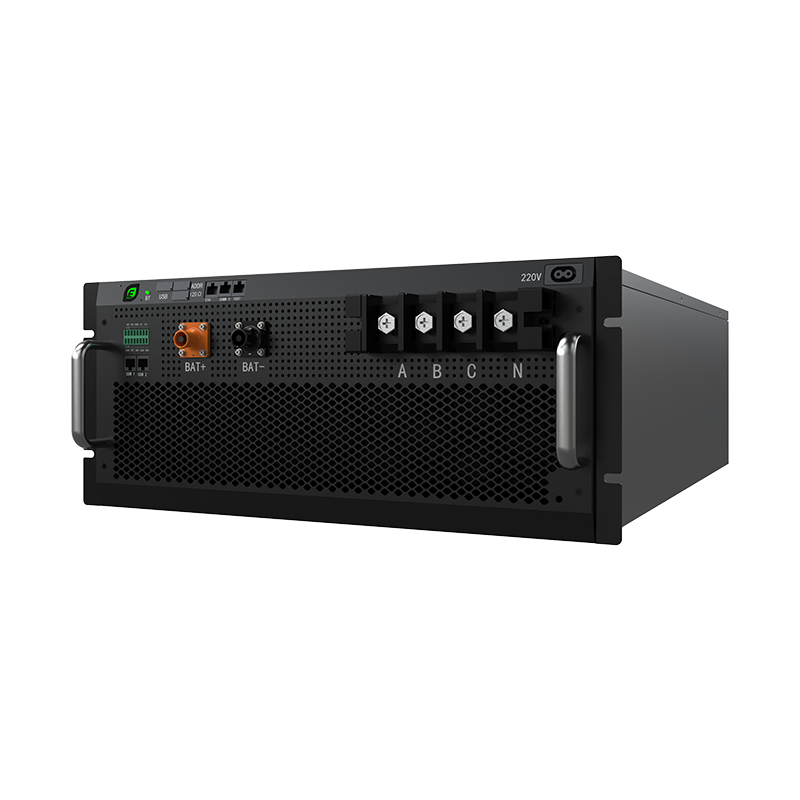
An active harmonic filter datasheet contains far more information than a rated-current figure. For industrial buyers, electrical engineers, and system integrators, the document provides the technical basis for determining whether a filter can match the site’s voltage, harmonic profile, response requirements, and installation conditions. Understanding these parameters also helps clarify questions such as What is the difference between AHF and PHF? and whether a harmonic filter can correct power factor.
Start With the Electrical Basics
The first section to examine is usually the electrical rating. Rated voltage, allowable grid-voltage range, frequency, rated current, and wiring configuration determine whether the active harmonic filter can operate within the facility’s electrical system.
Rated current is particularly important. An AHF does not need to be selected simply according to the total transformer capacity. Engineers should evaluate the actual harmonic current requiring compensation and consider operating conditions, future load growth, and available redundancy.
The number of supported phases and wiring arrangements also matter. For example, Enjoypowers’ published SinE Series specification supports both 3P3W and 3P4W grid types, with rated-voltage options covering 200/400 V, 690 V, and 800 V configurations.
What Is the Difference Between AHF and PHF?
A common technical question concerns the difference between AHF and PHF. AHF generally refers to an Active Harmonic Filter, which uses power electronics to detect harmonic currents and generate compensating currents. Enjoypowers describes its AHF as a parallel-connected device using current transformers to detect load current and compensate unwanted harmonic components.
PHF usually refers to a Passive Harmonic Filter. Passive solutions use combinations of capacitors, inductors, and resistors to provide frequency-selective filtering. Their behavior is therefore determined largely by the designed circuit characteristics.
The distinction matters when evaluating a project. Active filtering can dynamically respond to changing nonlinear loads, while passive filtering is generally designed around specific harmonic frequencies and operating conditions. The appropriate technology depends on the facility’s load profile, harmonic spectrum, system impedance, and project requirements.
Check the Harmonic Compensation Range
The harmonic-order range is one of the most important specifications on an AHF datasheet. It tells engineers which harmonic components the equipment is designed to compensate.
A facility may have several significant harmonic orders rather than one dominant frequency. Consequently, a datasheet that specifies only a broad THD performance figure may not provide enough information for system design.
Enjoypowers’ SinE Series documentation specifies compensation from the 2nd through the 50th harmonic order. It also lists a harmonic-reduction rate greater than 97.5% under its specified conditions.
Engineers should also examine how the manufacturer defines performance. Harmonic reduction depends on load conditions, system impedance, measurement location, and filter configuration. Datasheet figures should therefore be considered alongside actual site measurements.
Response Time Can Affect Equipment Selection
Response time indicates how quickly the filter reacts to changing power quality conditions. This parameter becomes increasingly relevant where nonlinear loads change rapidly.
Enjoypowers’ SinE Series datasheet specifies an overall response time of no more than 10 ms. Its documentation also identifies 20 kHz switching frequency and a three-level topology.
The significance of response time depends on the application. A steady industrial load may have different requirements from a data center, semiconductor facility, or other installation with rapidly changing electronic loads.
A datasheet should therefore be read in the context of the site’s operating behavior rather than treating a lower response-time number as universally necessary.
Does a Harmonic Filter Correct Power Factor?
Another important question is Does a harmonic filter correct power factor? The answer depends on the type of filter and its configuration.
Harmonic distortion and reactive power are related power quality concerns, but they are not identical. An active harmonic filter designed only for harmonic compensation should not automatically be assumed to provide reactive-power compensation.
Some multifunctional active filters can perform both functions. Enjoypowers’ SinE Series specification explicitly lists reactive-power compensation as available and states that its target power factor is adjustable from −1 to 1.
This distinction is important during procurement. If a facility needs both harmonic mitigation and power-factor correction, the engineering team should verify that reactive-power compensation is actually included in the selected configuration rather than assuming it from the term “active filter.”
Review Current Capacity and Scalability
Industrial electrical loads rarely remain constant. Production expansion, new drives, additional machines, and changes in operating schedules can increase harmonic demand over time.
A modular AHF architecture can make capacity planning more flexible. Enjoypowers’ SinE Series documentation states that up to 20 units can be combined, while its published technical data includes rated-current options of 30, 50, 75, 100, 150, and 200 A for the 200/400 V configuration.
For buyers, modularity should be evaluated together with installation space, maintenance strategy, redundancy requirements, and spare-parts planning.
Examine Environmental and Installation Specifications
A technically suitable filter can still be unsuitable if its environmental ratings do not match the installation site. Datasheets should therefore be checked for operating temperature, humidity, altitude, protection class, noise, and applicable standards.
Enjoypowers’ published SinE Series specification lists an operating temperature range of −35°C to 55°C, with derating above 55°C. It specifies derating above 2,000 m altitude, 5%–95% relative humidity without condensation, and IP20 protection.
These details are particularly relevant for industrial facilities where equipment may be installed in electrical rooms with elevated temperatures or challenging environmental conditions.
Read the Datasheet as an Engineering Document
A useful AHF datasheet should ultimately help engineers connect product capability with site requirements. Voltage, current capacity, harmonic-order range, response time, power-factor functions, scalability, environmental ratings, and communication interfaces all contribute to that decision.
Enjoypowers positions its SinE Standard platform as an IGBT-based active-filter solution for industrial power quality applications, while its broader portfolio also includes the SinL Pro platform based on SiC technology. The company’s power quality materials describe different platforms around response-speed and application requirements rather than treating every industrial installation identically.
For business buyers, understanding questions such as What is the difference between AHF and PHF? and whether a harmonic filter can correct power factor is only the beginning. is only the beginning. The strongest procurement decisions come from matching every relevant datasheet parameter with measured site conditions, operating requirements, and the long-term electrical strategy of the facility.
