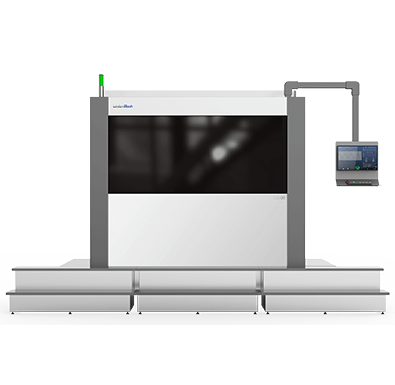
In industrial SLA 3D printing, post-processing is a necessary step to ensure that printed parts meet functional and surface quality requirements. While SLA technology can produce parts with relatively smooth surfaces directly from the build process, residual resin, incomplete curing, and support structures still need to be addressed before parts can be used in testing or assembly. In workflows involving a large industrial 3D printer, post-processing becomes more critical due to the size of parts and the need to maintain consistent quality across complex geometries. Manufacturers such as UnionTech design systems that allow post-processing steps to be integrated into overall production workflows rather than treated as isolated operations.
Cleaning and Resin Removal
The first stage of post-processing typically involves removing uncured resin from the surface of printed parts. This process is essential to prevent surface defects and ensure that subsequent curing steps are effective. In industrial environments using a large industrial 3D printer, cleaning procedures must remain consistent across larger surface areas and internal structures, which may trap residual material. Controlled washing systems and standardized procedures are therefore used to maintain repeatability, especially when parts are intended for functional validation or downstream finishing.
Secondary Curing and Material Stabilization
After cleaning, parts generally require secondary curing to achieve their final mechanical properties and dimensional stability. This step ensures that the material reaches its intended hardness and performance characteristics, which is particularly important for engineering applications. When parts are produced on a large industrial 3D printer, uniform exposure during post-curing becomes more complex due to part size and geometry. Systems developed by UnionTech are typically used in combination with controlled curing environments to ensure consistent results across different production batches.
Support Removal and Surface Adjustment
Support structures are necessary during the printing process but must be removed carefully to avoid damaging the part surface. In industrial SLA applications, this step directly affects final surface quality and may require additional finishing depending on the placement of supports. For parts produced using a large industrial 3D printer, support removal can involve larger contact areas or more complex geometries, which increases the importance of planning support strategies during the design stage. Surface adjustment after removal is often minimal compared to other additive methods, but it remains a controlled step in achieving final part quality.
Surface Finishing and Functional Preparation
Depending on the application, additional finishing processes such as sanding, polishing, or coating may be required to meet specific performance or aesthetic standards. In many industrial use cases, SLA parts already provide a sufficient surface baseline, reducing the extent of manual finishing needed. However, when parts are used for visual models, coating applications, or precise assembly, controlled finishing processes help ensure consistency. In workflows supported by UnionTech, these steps are typically aligned with production requirements to maintain efficiency when using a large industrial 3D printer.
Conclusion
Post-processing is an essential component of SLA 3D printing in industrial environments, ensuring that printed parts achieve the required mechanical properties, surface quality, and dimensional stability. From cleaning and curing to support removal and finishing, each step contributes to overall part performance. For companies operating a large industrial 3D printer, integrating post-processing into a stable and repeatable workflow is important for maintaining consistency across applications. Solutions developed by UnionTech demonstrate how equipment design and process coordination can support these requirements in practical manufacturing scenarios.
