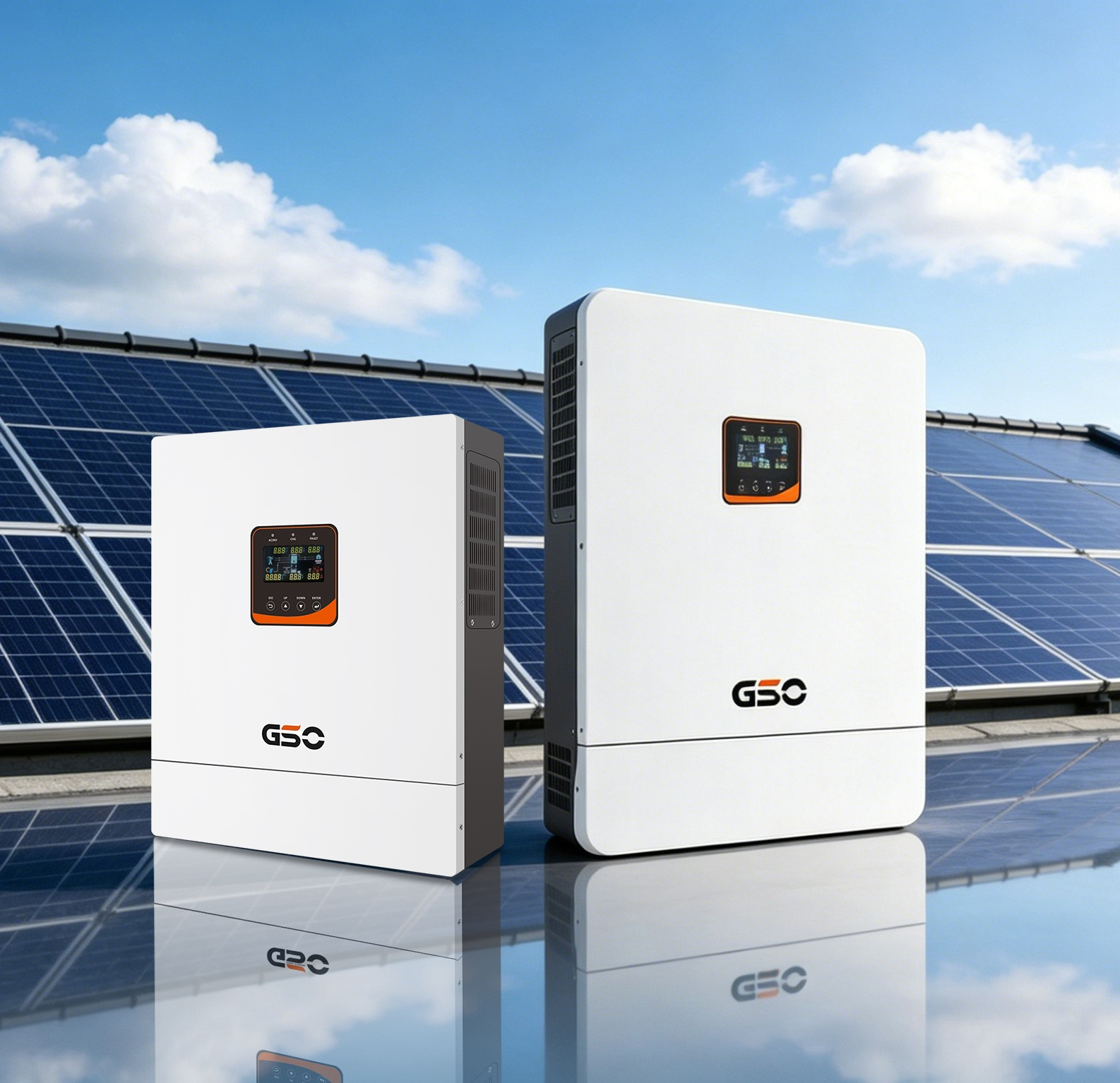
Not every solar installation needs the same AC architecture. Many homes operate on single-phase supply, while larger residences, commercial facilities and industrial loads may require balanced three-phase power. That distinction changes how inverter capacity, PV inputs and load distribution should be evaluated.
A hybrid solar power inverter designed for three-phase service combines solar conversion, battery charging, grid interaction and backup functions while delivering power across three phases. A three phase hybrid inverter is therefore best compared with alternatives by looking at the electrical problem each architecture is intended to solve.
Single-Phase and Three-Phase Systems Serve Different Loads
The central difference is the form of AC output. A three phase hybrid inverter is intended for projects that need balanced three-phase supply rather than residential-style single-phase output. For three-phase service, GSOpower‘s GST family is rated at 400 VAC and 50/60 Hz with pure sine-wave output, with 8.5 kW, 10.5 kW and 12.5 kW models.
A hybrid solar power inverter in this range also provides peak capacities of 17 kW, 21 kW and 25 kW respectively. Those figures make the platform relevant to larger and more balanced loads, but the advantage comes from matching the site’s electrical distribution rather than from treating three-phase equipment as inherently better.
A single-phase installation with modest demand may not benefit from the additional architecture. The comparison should therefore begin with the site’s supply arrangement and load distribution, because phase configuration is an electrical requirement rather than a simple performance tier.
Independent MPPT Inputs Change PV Design Options
Different roof orientations and shading conditions make separate PV tracking relevant to the comparison. The GST three-phase platform uses two independent MPPT inputs, allowing separate strings to be tracked individually. On the 12.5 kW model, a three phase hybrid inverter can accept up to 9 kW per MPPT, or 18 kW of total PV array power. The hybrid solar power inverter uses a 22 + 22 A PV input current, a maximum open-circuit voltage of 800 + 800 V, and a 200–650 V MPPT operating range, with a stated tracking efficiency of 99.9%.
Independent tracking can be useful where two array sections face different directions or experience different shading patterns, because each MPPT can respond to its own electrical conditions instead of forcing both sections to share one operating point. That flexibility can simplify array planning on sites where roof surfaces or available mounting areas cannot be arranged as one uniform solar field.
Battery and Grid Functions Distinguish Hybrid Operation
Battery storage marks a functional divide between a conventional grid-tied inverter and hybrid equipment: the latter adds a managed battery path to solar conversion and grid interaction. Battery connection remains based on a 48 V nominal platform, with 40–60 V operating limits and compatibility with lithium, lead-acid or user defined battery types. It can therefore move energy among PV, batteries, loads and the grid rather than depending on one source.
Charging options reinforce that difference. The hybrid solar power inverter provides maximum mains charging current of 100–120 A and maximum hybrid charging current of 180–260 A depending on the model. Charging modes include solar-only, grid-priority, solar-priority and hybrid charging, while timed charge/discharge scheduling can be used with time-of-use tariffs. The inverter can also start from PV without a battery when emergency operation requires it.
Scaling and Monitoring Affect Larger Installations
As project power grows beyond one unit, parallel expansion becomes part of the architecture rather than a secondary feature. Up to nine GST units can be paralleled, allowing a three phase hybrid inverter installation to scale from 8.5 kW to as much as 112.5 kW without changing inverter type. That capability supports multi-unit commercial projects where one device would not provide enough rated power.
The hybrid solar power inverter also supplies APP/cloud monitoring and RS485/CAN communication for PV, battery, per-phase load, grid and fault data, with Wi-Fi and 4G modules supported. Battery-to-inverter efficiency is rated at no less than 93%; a typical change between inverter and bypass operation takes 10 ms. The enclosure is IP20, operating temperature is -10 to 55°C, storage temperature is -25 to 60°C, and cooling uses a variable-speed forced-air fan.
Choose the Architecture From the Application
Three-phase hybrid equipment is suited to installations where the load structure justifies balanced three-phase output and where solar, storage and grid functions need to be coordinated. GSOpower lists applications including commercial rooftop solar, industrial backup, high-consumption residences above about 8 kW, microgrids, remote sites and multi-unit commercial installations. In those settings, a three phase hybrid inverter addresses both power distribution and energy-source management.
A hybrid solar power inverter should therefore be compared with single-phase or non-hybrid alternatives according to load architecture, PV design, battery requirements, charging strategy and expansion needs. The three-phase option is not a universal upgrade; it is a response to a different electrical scale and distribution pattern.
A non-hybrid grid-tied design may still be appropriate where storage and backup are unnecessary, while a single-phase hybrid design can remain suitable when the property does not require balanced three-phase output. The role of the three-phase option is ultimately defined by the site’s phase structure, power demand, array configuration and storage strategy rather than by specification count.
