Heavy-duty charging hubs handle higher electrical loads, frequent vehicle turnover, and longer operating hours than private charging points. Safety therefore depends on more than charger power. Operators also need to consider electrical isolation, connector ratings, enclosure protection, and emergency procedures. For mixed-use sites, an AC DC charger can support different vehicle types while reducing the need for separate charging areas.
Why High-Voltage Safety Requires More Than Power Ratings
High-voltage charging equipment must manage current flow under demanding conditions. Rated power is only one part of the safety review. Engineers also need to examine cable sizing, protective devices, grounding, insulation performance, and connector current limits. These factors affect how the system responds during normal charging and abnormal conditions.
Heavy-duty hubs serve several vehicles each day. Repeated plug-in and plug-out cycles increase wear on charging guns and cables. Operators should inspect connectors, locking mechanisms, cable jackets, and terminals during routine maintenance. Damaged parts can increase resistance and heat generation, especially when high current is involved.
The charging area also needs clear equipment spacing and technician access. Maintenance teams should reach protective devices without interfering with active charging positions. Clear labeling and emergency controls can reduce mistakes.
Connector Standards and Current Limits Matter
Connector selection should match the target market and expected charging load. European-oriented projects commonly use CCS2 and Type 2, while some North American projects use CCS1 for DC charging. Each connector must be paired with suitable cable and current specifications.
Current limits are especially important in high-voltage systems. Excessive current can increase thermal stress on connectors and internal components. Project teams should compare charging gun ratings with actual output current and expected vehicle demand before installation.
Mixed hubs may combine fast DC charging with lower-power AC charging. A DC and AC charger can suit locations where vehicles remain parked for different periods. Fast charging can serve short visits, while AC charging can support longer stays without occupying the higher-power DC output.
Protection Against Outdoor Operating Conditions
Many commercial hubs are installed outdoors. Dust, rain, humidity, and temperature changes can affect equipment over time. Enclosure design therefore needs to match the installation environment rather than relying only on internal electrical protection.
An IP rating gives project teams a reference for resistance to solid particles and water. It does not replace proper installation, drainage, cable routing, or maintenance. Site design should also prevent water from collecting around the equipment base and keep ventilation paths clear.
Regular inspection remains necessary after commissioning. Technicians should check enclosure seals, charging gun condition, ventilation openings, and signs of corrosion or overheating. Preventive checks can identify issues early.
How Integrated Charging Equipment Supports Mixed Sites
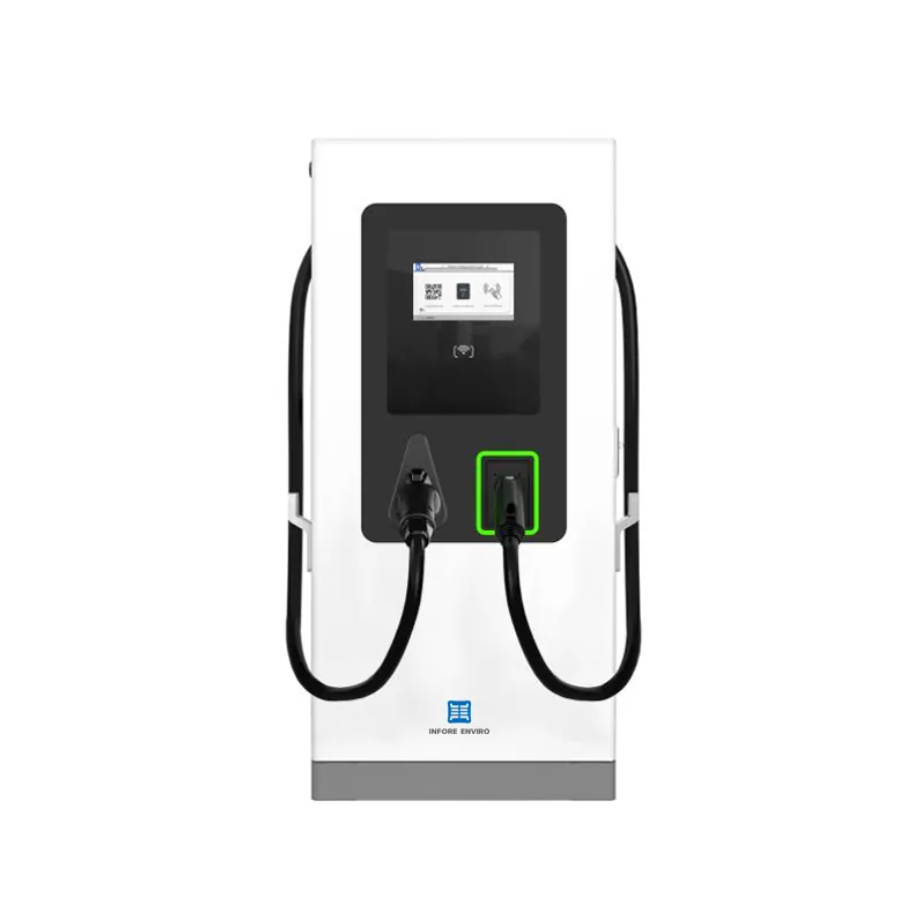
For projects that need both DC and AC charging, integrated equipment can reduce the number of separate cabinets required. One example is the DC60kW+AC22kW Vector Series DC Fast Charger associated with INFORE ENVIRO. It combines a 60kW DC output and a 22kW AC output in one floor-standing unit.
The unit has two guns. The DC side supports CCS2 or CCS1, while the AC side uses Type 2. Listed current ratings are 200A for CCS2 and 32A for AC. A 10.1-inch touchscreen provides the local interface, and the enclosure is rated IP54.
This configuration is intended for commercial workplaces, retail sites, hospitality locations, destination charging, and on-street charging. Dual-gun operation addresses different charging demands within one installation. In this role, the AC DC charger also becomes part of the site’s traffic and parking plan.
Site Controls and Operational Safety
Electrical safety should be supported by operational controls. Charging hubs need defined procedures for fault handling, emergency isolation, and maintenance access. Staff should know how to identify warning messages and when to remove a charging point from service.
Management platforms also matter in daily operation. Standard communication protocols such as OCPP can support charger monitoring, session records, and remote status checks. This helps operators review charger behavior alongside physical inspection.
Load planning is equally important. Combined demand from several charging points can affect upstream distribution equipment. Engineers should review transformer capacity, switchgear, cable routes, and expected simultaneous charging before finalizing hub design.
Practical Safety Priorities for Project Buyers
A heavy-duty hub should be assessed as a complete electrical installation rather than a collection of individual chargers. Buyers should review output power, connector type, current rating, enclosure protection, service access, communication capability, and site power supply together.
Product selection should also consider how different vehicles use the site. A DC and AC charger may provide more flexibility where dwell times vary, but the layout still needs to support safe parking, cable reach, and technician access.
For B2B project teams, supplier capability also affects implementation. INFORE ENVIRO focuses on EV charging products for commercial applications, and they provide equipment for different requirements. The key procurement question is whether the selected charger matches the electrical design, vehicle mix, and operating conditions.
Building Safer High-Power Charging Hubs
High-voltage safety depends on coordinated decisions across equipment, electrical design, installation, and maintenance. Power rating alone cannot show whether a charging hub suits long-term operation. Connector limits, enclosure protection, site layout, load planning, and operating procedures all need to be reviewed together.
For heavy-duty charging projects, a structured technical review helps teams identify risks before installation. Matching charger configuration to real vehicle behavior and site conditions can make the hub easier to operate, inspect, and maintain during operation.
