Selecting an industrial gas detector involves more than comparing prices, sensor counts, or product appearances. Industrial buyers need to consider target gases, measurement ranges, sensor performance, sampling methods, alarm systems, environmental protection, and long-term maintenance. The right equipment should match actual workplace hazards and operating conditions.
Understanding these factors helps procurement teams evaluate suppliers more effectively, avoid unnecessary features, and select reliable instruments for industrial safety management.
- Identify the Gases That Need to Be Monitored
The first step in purchasing gas detection equipment is identifying the gases present in the working environment. Different industries face different atmospheric hazards. Oil and gas facilities may need to monitor combustible gases and hydrogen sulfide, while chemical plants may encounter toxic substances such as ammonia, chlorine, or carbon monoxide.
Oxygen monitoring is another important consideration, particularly in confined spaces, underground facilities, and storage tanks. Oxygen deficiency can create serious risks even when toxic gas concentrations remain relatively low.
A multi-gas instrument can monitor several selected gases simultaneously, reducing the need for workers to carry multiple devices. However, buyers should not assume that a higher sensor count automatically provides better protection. The installed sensors must correspond to the facility’s risk assessment.
- Measurement Range, Accuracy, and Sensor Quality
Measurement range determines the concentration levels an instrument can detect. Before selecting a model, buyers should establish the expected gas concentrations and applicable workplace exposure limits. A detector designed for low-level atmospheric monitoring may not be suitable for every process measurement application.
Accuracy and resolution also influence purchasing decisions. Accuracy describes how closely a reading represents the actual concentration, while resolution indicates the smallest measurement increment displayed by the instrument. Response time is equally important because delayed readings can affect how quickly workers recognize changing atmospheric conditions.
Sensor technology deserves careful evaluation. Electrochemical sensors are commonly used for toxic gases and oxygen, while catalytic bead and infrared technologies are used for combustible gas detection in different applications. Sensor selection should reflect the target gas, operating environment, and maintenance requirements.
A qualified gas detector manufacturer should provide clear documentation covering sensor specifications, measurement ranges, calibration procedures, and expected service life. These details allow procurement teams to compare products using measurable technical criteria rather than general marketing descriptions.
- Sampling Methods and Operating Environments
Gas detectors commonly use diffusion or pump-based sampling. Diffusion instruments allow surrounding gases to reach the sensors naturally. Their relatively simple structure makes them suitable for personal monitoring and routine inspections.
Pump-based models actively draw gas through a sampling line. This arrangement is useful when workers need to check tanks, pipelines, ducts, or confined spaces before approaching or entering them. However, buyers should consider pump maintenance, tubing compatibility, sampling distance, and flow-rate requirements.
Environmental protection is another purchasing priority. Industrial equipment may encounter dust, moisture, vibration, temperature fluctuations, and potentially explosive atmospheres. Buyers should check ingress protection ratings and explosion-protection certifications to ensure compatibility with the intended installation or working area.
- Alarm Systems and Ease of Operation
A detector must communicate hazardous conditions clearly. Common alarm methods include audible signals, flashing lights, vibration, and visual indications on the display. Multiple warning methods are particularly useful in industrial environments where machinery noise or poor visibility may prevent workers from noticing a single type of alert.
The operating interface should also be straightforward. Workers may need to check readings, change settings, or respond to alarms while wearing protective equipment. Clear displays, accessible buttons, and understandable menus can reduce operating difficulties.
Battery performance, charging arrangements, and data management should be evaluated as well. For portable instruments, sufficient operating time is essential for long inspection shifts. For facilities with formal monitoring programs, data logging and communication functions may help maintain records and review equipment performance.
- BoseanK-40: Practical Multi-Gas Detection for Industrial Applications
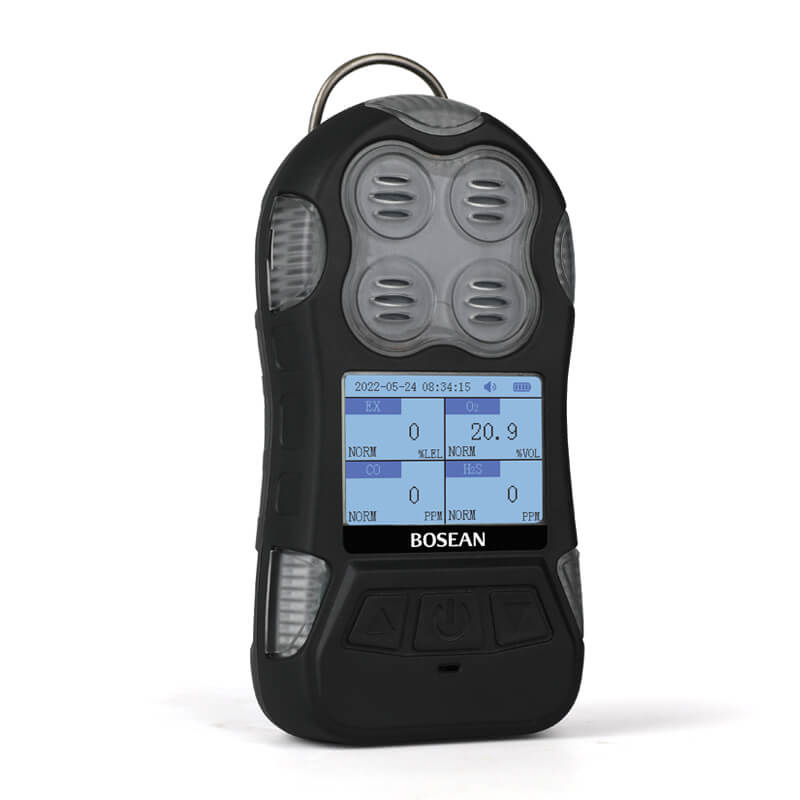
The Bosean K-40 is a four-in-one multi-gas detector developed for industrial gas monitoring. Its design combines large-scale integrated circuit technology, intelligent control, and proprietary digital-analog hybrid communication technology.
The instrument uses natural diffusion sampling and high-quality gas sensors. The design emphasizes sensitivity, repeatability, convenient operation, and straightforward maintenance. These characteristics make it relevant to organizations requiring portable monitoring for routine industrial inspections.
Its housing combines high-strength engineering plastics with composite non-slip rubber. The construction is designed to provide waterproof, dustproof, and explosion-proof protection, which is important for equipment used in demanding industrial environments.
The K-40 is intended for applications across oil and gas, chemical processing, environmental protection, metallurgy, refining, gas transmission and distribution, biochemical medicine, and agriculture. Its four-channel configuration can support monitoring of multiple selected hazards, although buyers should confirm the installed sensor combination, individual measurement ranges, accuracy, and certification before ordering.
For companies evaluating an industrial gas detector, this model provides an example of a multi-gas design that combines portable operation with practical housing and sensing features.
- Evaluating Suppliers and Long-Term Ownership Costs
Product specifications are only one part of a purchasing decision. Calibration services, sensor replacement, technical assistance, spare-part availability, and product documentation can influence the total cost of ownership.
An experienced gas detector manufacturer should be able to explain sensor limitations, recommend appropriate configurations, and provide guidance on calibration and maintenance. Buyers should also examine whether the supplier can support equipment throughout its expected service life.
Procurement teams should compare warranty conditions, delivery arrangements, technical response, and customization options. Selecting an industrial gas detector based solely on its initial price may create additional costs if maintenance or replacement support is difficult to obtain.
Making a Better Investment in Industrial Gas Safety
zChoosing suitable gas detection equipment requires balancing technical performance, workplace conditions, maintenance needs, and purchasing costs. The Bosean K-40 offers a four-in-one diffusion design with high-quality sensors and a durable housing for industrial applications.
As a gas detector manufacturer, Bosean develops and supplies gas detection and measurement instruments while providing technical services to customers. Businesses considering an industrial gas detector should verify the required sensor configuration and certification before purchasing. A well-matched instrument, supported by regular calibration and appropriate worker training, can contribute to a more dependable industrial safety program.
