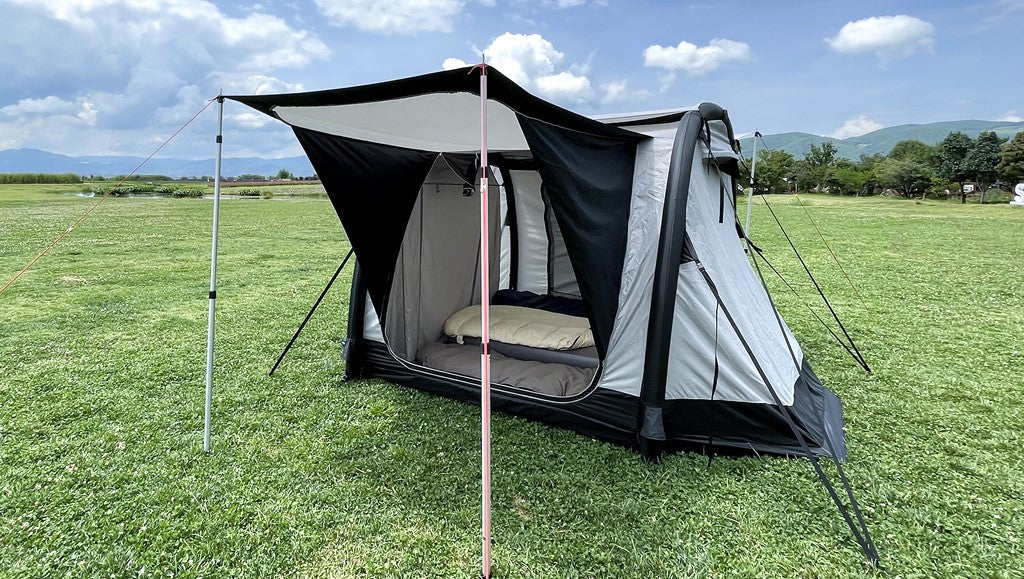
Beach campsites test gear differently than inland forests or mountain trailheads. There is rarely a stand of trees or a ridge to soften a steady onshore breeze, sand works its way into zippers and seams, and salt-laden air is harder on metal hardware than dry inland air. A tent chosen for general car camping does not automatically account for these conditions, which is why beach-specific setup habits matter about as much as the tent itself.
Wind Exposure Without Natural Cover
Open shoreline wind behaves differently from wind in a wooded campsite. It is often more sustained and tends to come from a fairly predictable direction, off the water, instead of gusting around obstacles. That predictability is useful: a vehicle parked with intention can act as a windbreak in a way a freestanding tent cannot.
This is where a car extended tent has a practical advantage on an exposed beach. THECATAL’s Smart Shell can be set up at the rear or side of a vehicle, or on its own as a standalone shelter. When it is attached to the car, the vehicle’s position becomes part of the campsite layout, and parking with the body facing the prevailing wind lets the car take some of the direct load instead of leaving the tent fully exposed to incoming gusts.
What “Windproof” Covers and What It Leaves Open
The Smart Shell is built to be waterproof, windproof, snow-proof, and heat-resistant, using silicone-coated ripstop 70D nylon. For a beach trip, “windproof” works best as a general description of durability rather than a numerical limit. A large vehicle-attached shelter presents a bigger surface to the wind than a compact backpacking tent, so strong, sustained coastal wind is a good reason to lean on positioning and a careful forecast check instead of the fabric alone.
If a squall is forecast, taking the tent down and waiting it out is a reasonable call, whatever the construction.
Choosing the Site Before Pitching Anything
Good beach camping starts before the tent comes out of the bag. Local rules differ widely: some beaches prohibit vehicles on the sand, restrict camping to marked areas, or close sections during wildlife nesting seasons. Checking the managing authority’s rules and the tide table before the trip prevents the most common surprises.
Where driving onto the beach is allowed, the surface matters as much as the rules. Firm, damp-packed sand near the middle of the beach carries a vehicle far more reliably than dry, loose sand near the dunes. A car that gets stuck takes its attached tent with it, so parking on firm ground is part of the shelter plan. Dunes themselves are fragile and often protected, and they are best left as a scenic backdrop rather than a place to anchor gear.
Salt Air, Sand, and What Needs Attention
Corrosion is a slower, less dramatic problem than wind, but it builds up over repeated beach trips when hardware is left alone. Salt residue collects on zippers, connectors, and any metal parts, and a fabric rating describes the fabric, not the hardware attached to it.
Care after the trip does most of the work. Rinse salt and sand from zippers and seams with fresh water, then let the tent dry completely before it goes into storage. Dirt can be removed with mild soap, and the tent should be packed loosely instead of compressed tightly for long periods. These habits reduce the risk of stiff zippers, mildew, and fabric fatigue between trips.
Keeping Sand Out of the Living Space
Sand is easier to keep out than to remove. A doormat or small tarp at the entrance gives everyone a place to knock off their feet, and a rule of shoes off before stepping in saves a lot of sweeping later. A ground sheet inside the shelter makes cleanup faster, since it can be lifted and shaken out in one move. Dry sand brushes away easily, while wet sand smears and sticks, so it is better to let it dry first. Phones, cameras, and chargers last longer in sealed bags, because fine sand finds its way into ports and buttons.
Heat and Airflow on an Open Beach
Open sand has little shade, and a closed tent can get warm by midday. The Smart Shell can connect to the vehicle’s air conditioning system, electric or gasoline-powered, which allows the temperature inside to be adjusted, and the shell itself is heat-resistant.
On a gasoline vehicle, the connection avoids the tailpipe, but exhaust clearance should still be checked before installation, and the car should be parked with open air around the tailpipe.
Setup Considerations for Sand and Shifting Ground
Sand adds a wrinkle that solid ground does not. Stakes hold less reliably, and a campsite’s usable footprint can shift with the tide line during a multi-day stay. The Smart Shell’s interior measures 3.5 m × 2.5 m (11.5 ft × 8.2 ft), and setup takes about 3 minutes with no complex assembly, so repositioning above the tide line is a manageable task.
Campers considering an outdoor car tent for repeated beach trips can improve holding power in loose sand with deeper stake angles, buried anchors, or weighted bags on the guy lines. Choosing a spot well above the high-water mark, with level ground for the tent and the parked vehicle, matters more than any single piece of hardware. The complete tent weighs 26 lb (12 kg), which makes it practical to carry across a parking area to a beachside site.
Bringing Wind and Corrosion Fixes Together
None of these adjustments require different gear so much as different habits: orienting the vehicle to break the prevailing wind, treating a general windproof rating as a baseline instead of a tested ceiling, and rinsing and drying hardware after salt exposure rather than assuming the fabric’s waterproofing covers every part of the tent.
Beach camping does not demand a tent category of its own, but it rewards a coastal checklist of wind orientation, salt cleanup, and sand-aware setup on top of a weather-rated shelter. THECATAL backs the Smart Shell with a two-year warranty, which adds some reassurance for a tent that will see repeated trips.
